

Case Study
Consulting Firm Rebrand and Thought Leadership Drives 22% Growth
Marketing Strategy
Branding
Thought Leadership
Content and Creative
How Scribewise Turned Differentiation Into Growth
for a Boutique Consulting Firm
- Clarified the firm’s core differentiator: working shoulder to shoulder rather than handing off strategy
- Turned real sales conversations into targeted thought leadership used directly in follow-ups
- Built a differentiated brand that strengthened enterprise credibility and enabled more confident competition
- Enabled a measurable return following the brand launch, including 22 percent revenue growth

After three years of flat revenue, Navigate—a boutique management consulting firm—needed a clearer way to stand out and grow beyond referrals. Scribewise helped the firm articulate its Neon Fingerprint, turn thought leadership into sales assets and support a return to growth, including a 22 percent revenue increase following the new brand launch.
The Situation: A Successful Firm, Stuck
Navigate helps large, complex organizations improve performance by changing how people work together and how value is delivered. After more than a decade of growth, the firm had reached a familiar but dangerous plateau: Revenue had been flat for three consecutive years, despite a strong economy and a track record of successful client work.
The issue was reach. As is the case for many consulting firms, Navigate’s growth had long been driven by personal networks and referrals, anchored in a well-connected founder and senior partners. Over time, that model began to strain. As they reached the end of those networks, new opportunities became harder to generate, and expansion beyond existing relationships slowed.
At the same time, a disproportionate share of revenue came from a single client, concentrating risk and increasing pressure to diversify. Navigate needed to compete more consistently for enterprise work outside its immediate circle. But in sales conversations, buyers still defaulted to larger firms they already knew or treated Navigate as a capable alternative rather than a clear choice.
Navigate didn’t need volume. It needed to win its next five to 10 enterprise clients without relying on personal referrals.
The Challenge: Competing With Giants and Blending In
Navigate operated in a consulting market dominated by global firms like McKinsey, BCG, Bain, Deloitte and Accenture, alongside a crowded field of capable boutique competitors.
The firm’s work was strong, but that strength didn’t translate consistently in sales conversations. When buyers evaluated transformation partners, they tended to default to the safe choice—larger firms they already knew. And when they didn’t, Navigate often blended into a group of boutiques that all sounded experienced and credible—but largely interchangeable.
Internally, leadership recognized that the issue wasn’t performance or expertise. It was differentiation. The brand wasn’t giving buyers a clear reason to choose Navigate, especially outside existing relationships.
As a result, even when Navigate made it onto shortlists, it was often treated as a capable alternative rather than a clear choice. The firm needed a sharper way to signal difference and earn confidence early in the buying process.
Turning Navigate’s Way of Working Into a Differentiator
Navigate operated in a consulting market dominated by global firms like McKinsey, BCG, Bain, Deloitte and Accenture, alongside a crowded field of capable boutique competitors.
The firm’s work was strong, but that strength didn’t translate consistently in sales conversations. When buyers evaluated transformation partners, they tended to default to the safe choice—larger firms they already knew. And when they didn’t, Navigate often blended into a group of boutiques that all sounded experienced and credible—but largely interchangeable.
Internally, leadership recognized that the issue wasn’t performance or expertise. It was differentiation. The brand wasn’t giving buyers a clear reason to choose Navigate, especially outside existing relationships.
As a result, even when Navigate made it onto shortlists, it was often treated as a capable alternative rather than a clear choice. The firm needed a sharper way to signal difference and earn confidence early in the buying process.
Building the Program: From Positioning to Sales Enablement
The work unfolded in two phases, moving from brand articulation to sales-ready thought leadership.
Clarifying the Brand and Launching the Platform
Scribewise focused on making Navigate’s thinking visible and usable in real sales conversations.
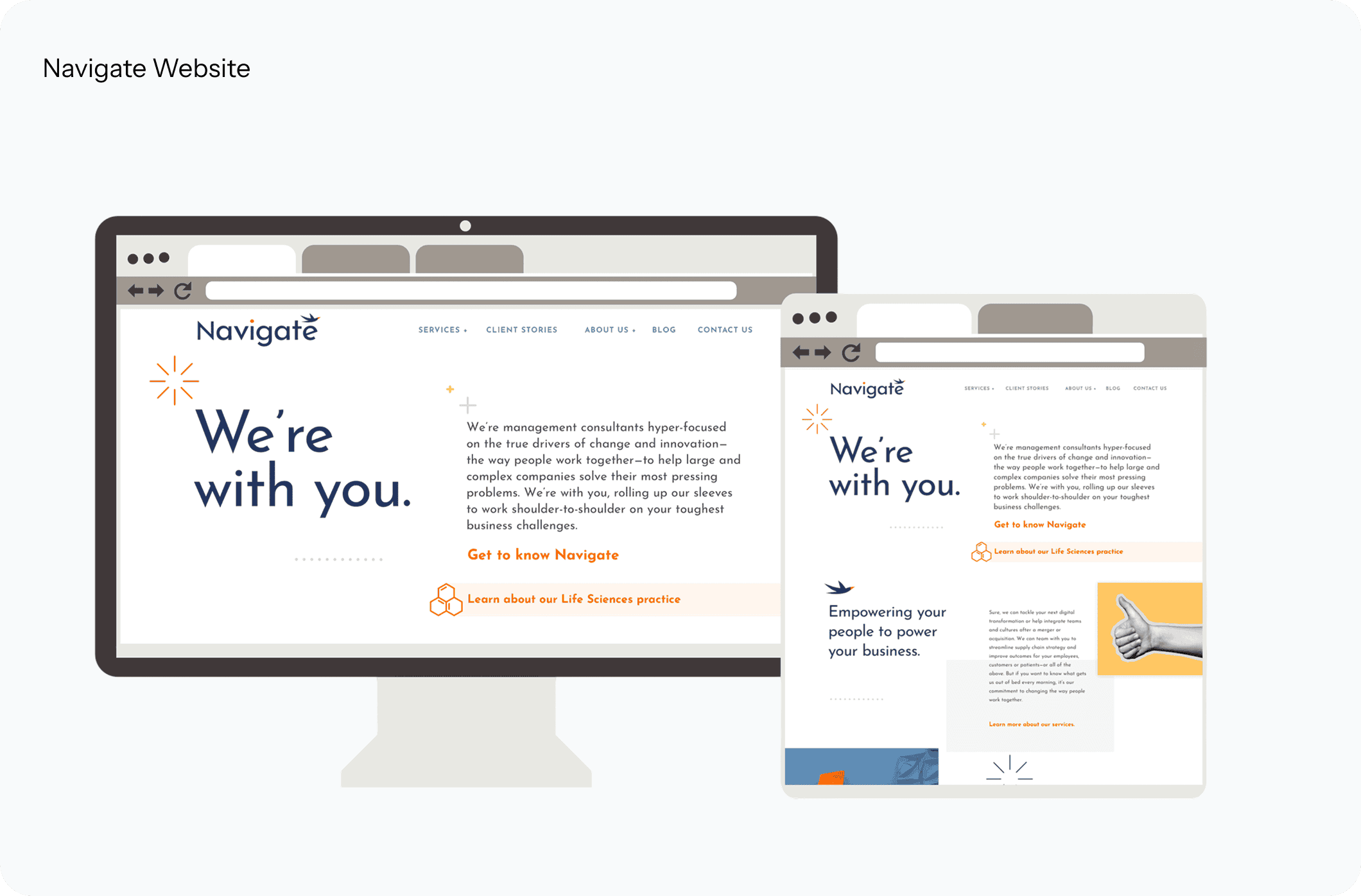
The engagement began with articulation and alignment to clarify Navigate’s brand story, messaging and visual identity. Scribewise then designed, wrote and built a new website to support enterprise credibility and anchor the brand launch.
Turning Sales Conversations Into Thought Leadership
From there, the focus shifted to thought leadership built from live sales conversations. Success hinged on earning credibility in the moments that actually influenced buying decisions—not broadcasting a message to the universe.
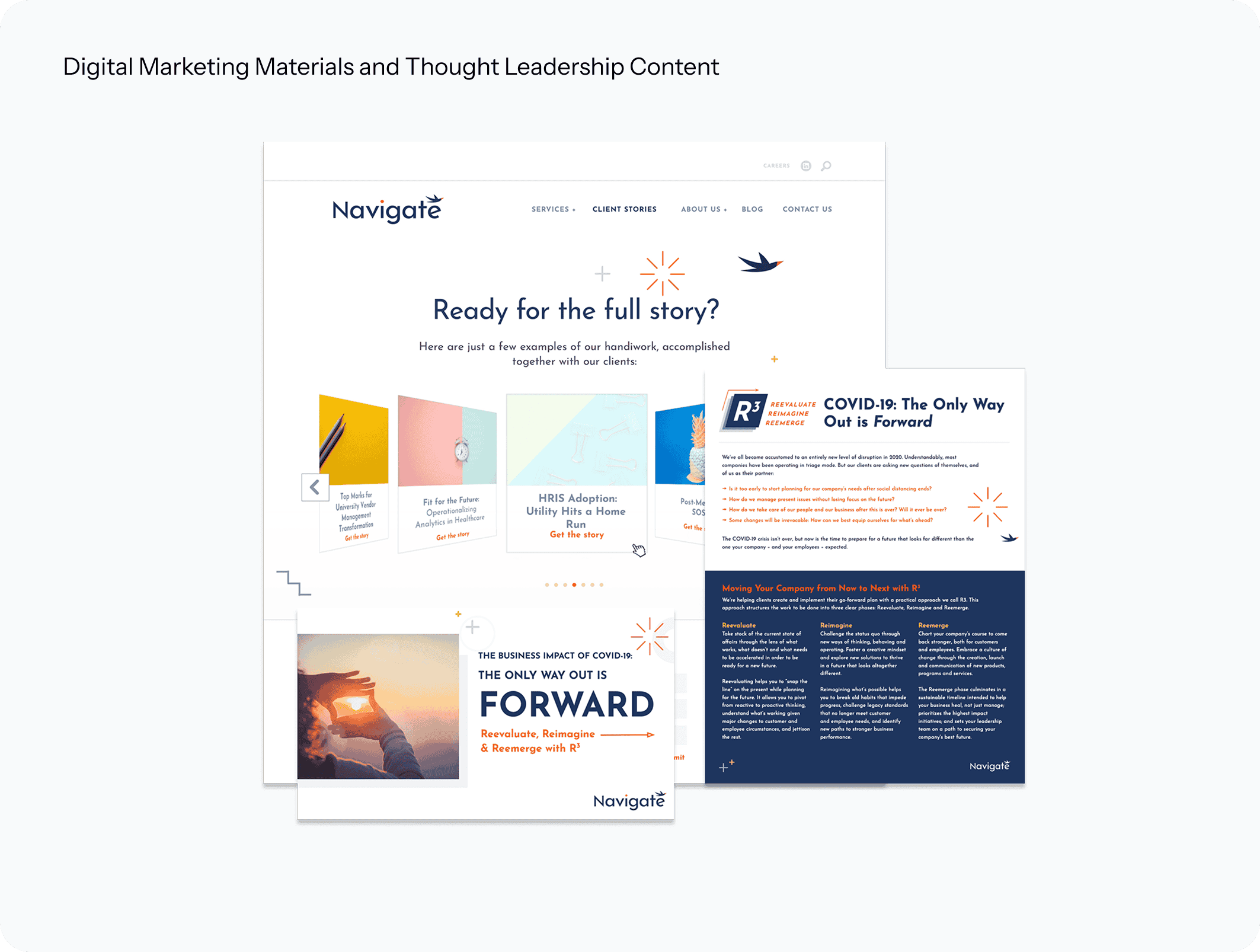
Partners and subject matter experts shared the questions they were hearing from prospects. Scribewise translated those conversations into articles and points of view, which partners then shared back with prospects as follow-up. Internally, this practice became known as “thoughtful shares.”
The result was a modified account-based approach: highly targeted, relationship-driven and designed to move specific conversations forward rather than generate vanity metrics.
To encourage adoption, Scribewise removed friction wherever possible. Content was interview-driven, reflected consultants’ actual language and delivered in plug-and-play formats. Initial skepticism faded as partners saw their thinking accurately captured and actively supporting business development.
The Results: Credibility, Then Growth
Before revenue moved, early signals pointed to real change:
- The new brand generated internal momentum
- Partners increasingly used thought leadership in active conversations
- Thought leadership became part of how Navigate followed up, reinforced credibility and stayed present with prospects
Navigate shifted from depending almost entirely on personal ties to strengthening those relationships with visible expertise and a distinct point of view.
In the year following the brand launch, Navigate achieved 22 percent revenue growth.
Several business changes contributed to that return to growth, but the rebrand and thought leadership were what enabled it—by elevating Navigate’s credibility and clarifying its value with enterprise buyers.
As Partner Brian Lee at Navigate later put it, “You guys are a huge part of our success.”
What’s Next: Making Differentiation Stick
The work established a durable foundation for Navigate’s growth, embedding thought leadership into how the firm showed up in sales conversations and how it put its expertise to use.
For boutique professional services firms, Navigate’s experience underscores a repeatable truth: Growth doesn’t come from louder marketing. It comes from clearer differentiation, usable ideas and the confidence to show how you actually work.